Rescue Tube Sizes: Why Length Matters
Rescue tubes are sold in three lengths: 40, 45, and 50 inches. The default for most aquatic facilities is the 45-inch model. That's often the wrong default. Here's how to think about it.
What length actually changes
Length determines three things: buoyancy, victim wrap, and reach.
Buoyancy scales roughly linearly with length, since the cross-section of a rescue tube is fixed at about 6 inches and the foam density doesn't vary between models from the same manufacturer. A 40-inch tube provides around 30 pounds of buoyant lift; a 45-inch tube around 35 pounds; a 50-inch tube around 40 to 45 pounds depending on density spec.
Wrap is the amount of tube material available to bring around a victim's torso when the buckle is clipped. A 40-inch tube wraps around a small adult or a child with margin. A 45-inch tube handles most adult victims. A 50-inch tube wraps around a larger adult and still has clip closure margin, or it can be used to bridge across two victims clinging to the same tube.
Reach is the distance you can put between yourself and a panicked victim while still maintaining contact. The longer the tube, the more buffer you have to hand the tube off without becoming a contact target yourself. In active drowning rescues this matters.
The case for 40-inch
A 40-inch tube is the right call only in narrow circumstances:
- Small facility pools. Backyard-sized lap pools, summer camp pools 25 yards or shorter.
- Children's swim programs. Where the realistic victim profile is a child under 60 pounds.
- Shallow water. Wading pools, splash pads with adult supervision and depths under three feet.
- Junior guard programs. Where smaller guards (16-year-olds, etc.) work with the tube and the larger sizes feel unwieldy.
Outside of those, you're trading rescue capacity for something you don't need.
The case for 45-inch
A 45-inch rescue tube is the workhorse default for general pool lifeguarding:
- Standard community pools with adult and youth swimmers, 8–12 foot deep ends.
- Aquatic centers with a mix of lap, recreation, and instructional swim.
- Indoor pools where water is warm and victim sizes are typical.
- Health-club pools and university recreation pools.
It's the safest, most versatile general-purpose choice. If you're equipping a typical aquatic facility and don't have specific reason to size up, 45 inches is the answer.
The case for 50-inch
A 50-inch tube is the right call for any of the following:
- Deep water. Diving pools, scuba training pools, deep-water fitness pools where rescues happen at depth and the victim has more vertical to fight against gravity. The extra buoyancy is what gets the victim to the surface and keeps them there.
- Surf and ocean lifeguarding. Saltwater is more buoyant than fresh, but conditions are harder. Wave action, current, and the realistic possibility of multiple victims in a single rescue all argue for the longest tube available.
- Water parks. Lazy rivers, wave pools, and slide catch pools regularly produce multi-victim incidents. A 50-inch tube can support a guard plus two clinging victims; a shorter tube can't.
- Heavier adult victims. Population averages shift, and rescue tube specs haven't. The 35-pound buoyancy of a 45-inch tube is not enough to comfortably support an unconscious 250-pound adult on the surface during an in-water rescue breathing scenario. A 50-inch tube has the margin.
- Two-victim potential. Facilities that run swim instruction, parent-and-child programs, or any environment where one drowning person grabbing onto another is realistic.
- Public beaches. Larger victims, deep water, surf — the trifecta argues for 50-inch tubes at every guard tower.
The cost argument
The price difference between a 45-inch and 50-inch tube is typically $5 to $15 at retail, depending on the manufacturer. Over a five-year service life, that's a couple of dollars a year per tube. There is essentially no economic argument for sizing down on rescue equipment.
What head guards actually order
Surveying head guards and aquatic directors at YMCA, municipal, and water park facilities, the most common sizing pattern is:
- Indoor pools: 45-inch
- Outdoor pools with deep ends: mix of 45 and 50
- Water parks: 50-inch standard, with 45-inch sometimes at kids' splash areas
- Beaches: 50-inch
The bias toward 45-inch in pools is mostly inertia from when 45 was the default catalog item. If you're spec'ing fresh, 50-inch is rarely wrong for any deep-water setting.
The audit question. If you have a multi-victim rescue and a coroner's inquest determines that a longer tube would have changed the outcome, you'll be answering questions about why you specified 45-inch when 50-inch was available at trivial extra cost. That's the calculation, stripped down.
Buoyancy in numbers
| Tube length | Approximate buoyancy | Adults supported (head above water) |
|---|---|---|
| 40" | ~30 lbs | 1 small adult or child + guard |
| 45" | ~35 lbs | 1 average adult + guard |
| 50" | ~40–45 lbs | 1 larger adult + guard, or 1 adult + 1 child |
"Buoyancy" here is the static lifting force the tube provides when fully submerged. The practical capacity in a real rescue is lower, since the tube isn't fully submerged when wrapped around a victim. But the relative scaling is what matters: a 50-inch tube has roughly 33% more lift than a 40-inch.
What about really long tubes?
Some manufacturers offer 60-inch and even 72-inch rescue tubes for surf and ocean rescue. These are specialty items. The trade-off is that very long tubes are unwieldy on patrol — they trail in the sand, snag in tower equipment, and slow the swim. For 95% of US aquatic facilities the right choice is 50-inch.
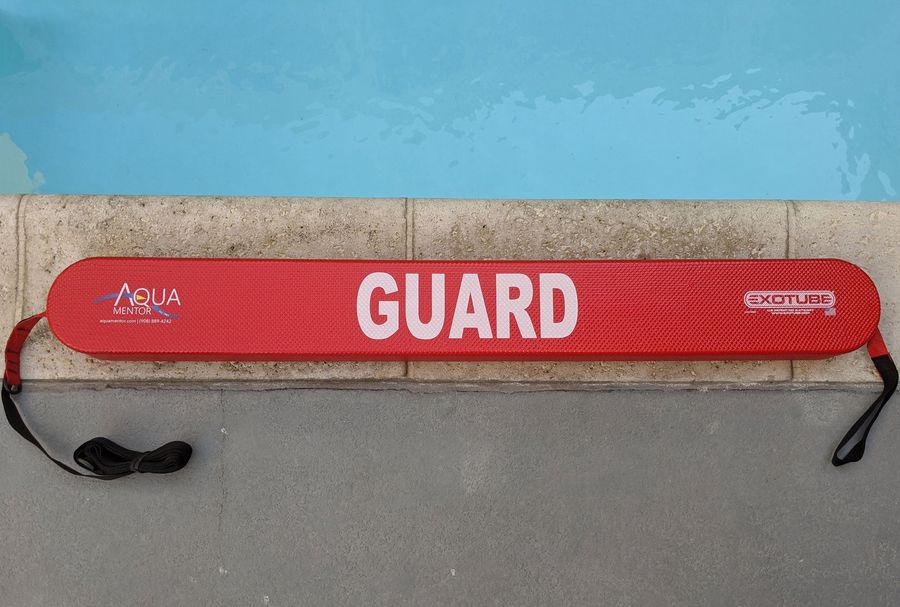
The 50-inch ExoTube
The Aquamentor ExoTube is a 50-inch closed-cell foam rescue tube — brass hardware, UV-stabilized vinyl skin, replaceable tow line. The extra length matters when it matters.
ExoTube specs and pricing →Related
-
Rescue Tubes: The Complete Lifeguard's Guide
The pillar guide — what a rescue tube is, types, sizes, and how to choose one.
-
Foam vs. Inflatable Rescue Tubes
Why every professional aquatic facility uses closed-cell foam.
-
Choosing Rescue Tubes for Your Aquatic Facility
A complete buying framework for facility operators.