Rescue Tube vs. Ring Buoy: When to Use Which
Rescue tube and ring buoy are not interchangeable. A practical comparison — buoyancy, technique, regulatory positioning, and which is right for your environment.
Two pieces of equipment, two different jobs
Walk into any aquatic facility and you’ll likely see both: a rescue tube on the guard stand and a ring buoy mounted to the wall or hung at the deck. They look related — both are buoyant, both have a line, both are used to keep someone afloat — but they’re built for different rescues. The decision of which to deploy in any given incident is a judgment call lifeguards train for, and the equipment selection is a decision aquatic directors and pool operators make when stocking a facility.
This article walks through the design differences, the rescue scenarios each tool is suited to, and what most certifying bodies say about which one belongs where.
What a ring buoy is, briefly
A ring buoy — sometimes called a life ring, lifebuoy, or PFD Type IV throwable — is a rigid or semi-rigid annular flotation device, typically 20 to 30 inches in outside diameter, made of foam or kapok with a vinyl skin or fabric cover. A length of buoyant rope (usually 50 to 90 feet) is attached. Ring buoys are designed to be thrown to a victim from shore, dock, or boat, with the line allowing the rescuer to retrieve the victim by pulling on the rope.
The U.S. Coast Guard classifies ring buoys as Type IV personal flotation devices, meant to be thrown rather than worn. They are required equipment on commercial vessels and many recreational boats; the USCG Office of Boating Safety publishes the federal carriage requirements.
What a rescue tube is, briefly
A rescue tube is a longitudinal flotation aid — a long cylindrical or shaped foam body, typically 40 to 50 inches long, with a tow line and shoulder strap. The lifeguard takes the tube into the water, swims to the victim, and uses the tube as a flotation platform that wraps around or supports the victim during the tow back to safety.
Rescue tubes are not classified as PFDs; they are professional rescue equipment. They are referenced as the primary in-water rescue device by the American Red Cross lifeguarding curriculum and required at all Ellis & Associates-audited facilities.
The fundamental difference
A ring buoy is thrown to a conscious, cooperative victim within close range — the victim grabs it and the rescuer pulls them in. A rescue tube is taken into the water by a trained lifeguard and used as both a flotation aid and a control point during an in-water rescue.
Put simpler: ring buoy = land-based assist; rescue tube = in-water rescue.
When to use each
Ring buoy: ideal scenarios
- Conscious victim within throwing range (typically under 50 feet from a stable platform).
- Rescuer cannot or should not enter the water — common from boats, piers, sea walls, ice, or in conditions hostile to swimming.
- Victim is alert enough to grab and hold a thrown object.
- Open-water boating environments where the rescuer is on the boat and the victim is in the water.
Rescue tube: ideal scenarios
- Active drowning (the panicked, vertical, climbing-motion victim) where the lifeguard must approach in the water.
- Distressed swimmer beyond easy throw range — mid-pool, far end of a wave pool, lazy-river bend.
- Unconscious victim requiring in-water support to keep airway above water.
- Multi-victim scenarios where one tube can support several distressed swimmers simultaneously.
- Any rescue requiring the rescuer to physically reach and control the victim.
Throw-to vs. swim-to: the key tactical split
Both tools work by getting flotation to a victim, but the path the rescuer takes is opposite. With a ring buoy, the rescuer stays on a stable surface and the equipment travels to the victim. With a rescue tube, the rescuer travels to the victim with the equipment in tow.
Each path has trade-offs:
- Ring buoy: faster (no swim time), safer for the rescuer (no in-water exposure), but requires victim cooperation, accurate aim, and victim within range.
- Rescue tube: works on uncooperative or unconscious victims, works at any range a lifeguard can swim to, but takes longer and exposes the rescuer to the water.
What lifeguard certifying programs say
Both Red Cross and Ellis & Associates train lifeguards on a tiered response: try the lowest-risk tool first if it’ll work. The general decision tree:
- Reach with a pole, shepherd’s crook, or arm if the victim is at the wall.
- Throw a ring buoy or rescue tube if the victim is within line range and conscious.
- Wade with equipment in shallow water if depth allows.
- Swim with a rescue tube as the primary in-water rescue device when the previous options aren’t viable.
The rescue tube isn’t the first choice in every scenario; it’s the right choice for the most common pool and beach scenarios where reach and throw aren’t enough.
Where each belongs in a facility
Most aquatic facilities stock both. Typical placement:
- Rescue tubes: one per active guard station, plus a small reserve. Carried over the shoulder during patrol.
- Ring buoys: mounted at fixed points around the deck or attached to deep-water access ladders. Also at boating docks and piers, per Coast Guard requirements.
The ring buoy is a passive backup — useful when there’s no guard nearby, in after-hours emergencies, or when bystanders need an option before professional rescue arrives. The rescue tube is the active tool, used by trained personnel as part of an integrated lifeguarding response.
Specifications matter for both
Both pieces of equipment have material and sizing standards. For ring buoys:
- USCG-approved Type IV for any commercial vessel application.
- Outside diameter: 24″ or 30″ for adult use; smaller models exist but most facilities standardize on 30″.
- Line: 60–90 feet of buoyant polypropylene line, attached to the buoy with a swivel to prevent tangling.
- Hi-vis color: orange or red is standard; white is sometimes seen but harder to spot in chop.
For rescue tubes:
- Closed-cell foam core — never inflatable for facility use.
- 50″ length for most adult-and-multi-victim scenarios; 45″ or 40″ only in small or shallow facilities.
- Vinyl skin with UV stabilization.
- Brass or stainless hardware (clips, eyelets) for chlorine and salt tolerance.
- 6–8 foot tow line with replaceable connection.
Common mistakes
- Using a ring buoy as a primary in-water rescue device. If the victim is unconscious or panicked, throwing flotation isn’t enough — the rescuer needs to get there.
- Leaving the rescue tube on the stand during patrol. Tube stays on the guard’s shoulder; otherwise response time loses 5–10 critical seconds.
- Not checking the ring buoy line. The rope tangles or rots while no one’s using it. Inspect monthly.
- Mismatching equipment to environment. A pier-end ring buoy doesn’t replace having lifeguards on duty for swimmers.
The short version
Use a ring buoy when you can stay out of the water and the victim can grab. Use a rescue tube when a trained lifeguard has to enter the water. Most facilities need both. Neither replaces the other.
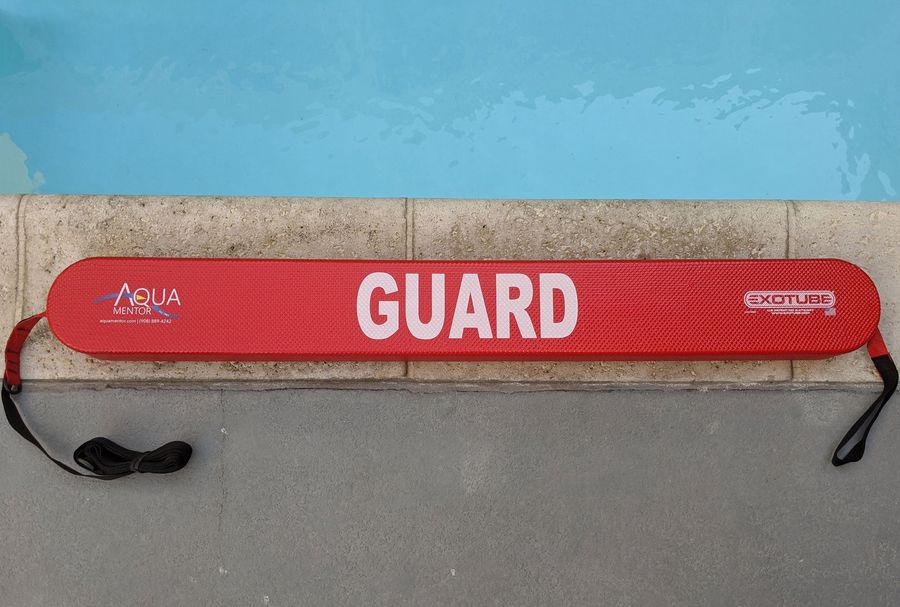
Aquamentor ExoTube
The Aquamentor ExoTube — 50″ closed-cell polyethylene foam, brass hardware, replaceable tow line. Made in the USA, in Garwood NJ since 1983. Bulk pricing for facility orders.
See the 50″ ExoTube on Aquamentor →Related
How to Use a Rescue Tube
Approach, contact, control, tow — the four phases of an in-water rescue.
Foam vs. Inflatable Rescue Tubes
Why facility lifeguarding standardized on closed-cell foam.