Choosing Rescue Tubes for Your Aquatic Facility
Spec'ing rescue tubes for a pool, water park, or summer camp involves more than just picking a length. This is the framework head guards and aquatic directors use to get the order right.
How many tubes do you actually need?
Two answers — minimum and recommended.
Minimum: one rescue tube per active guard station, plus one per backup guard, plus a small reserve at the guard office. That's the floor for any audit or insurance review.
Recommended: 1.5x the number of active guard stations. The extra inventory covers tubes that are out of service for cleaning or repair, tubes lost or damaged mid-season, and the practical reality that you'd rather have a guard grab a fresh tube during a quick changeover than fight with a worn one.
Specific examples:
- Community pool, 4 guard stations, 2 backup guards. Minimum 6 tubes; recommended 8–10.
- Water park, 18 guard stations, 6 floaters. Minimum 24 tubes; recommended 30–36.
- Summer camp, 2 stations on the waterfront, 1 backup. Minimum 3 tubes; recommended 5–6 (covers training drills and second-session rotation).
Sizing across stations
You don't need to pick one size for the whole facility. Many facilities mix sizes by station:
- Deep end, diving well, lap pool: 50-inch tubes
- Recreational pool, lazy river: 50-inch tubes
- Wave pool, surf pool: 50-inch tubes
- Shallow end, kids' splash area: 45-inch tubes
- Wading pool, splash pad: 40-inch tubes (if any tube — some splash pads use other rescue equipment)
Standardizing sizing across the facility is simpler operationally, and it's what most aquatic operators do. If you're going to standardize on one length, 50-inch is the safe call: it works at every station, it covers worst-case scenarios, and the cost difference vs. 45 is trivial. See our breakdown on rescue tube sizes for the full reasoning.
Specification checklist
When you're ready to write a purchase order, the spec sheet should call out:
- Length — 40", 45", or 50"
- Construction — closed-cell polyethylene foam (NOT inflatable)
- Skin material — UV-stabilized vinyl, ideally with antimicrobial treatment for indoor pools
- Skin thickness — minimum 0.025" (cheap tubes are 0.015")
- Hardware — brass or stainless steel clips (avoid plastic, avoid uncoated steel)
- Tow line — 6 to 8 feet, polypropylene or nylon, replaceable
- Shoulder strap — 1.5" or 2" nylon webbing, adjustable
- Color — international red/orange or yellow are the standard. Manufacturer logos on the body are fine; busy graphics are a distraction
- Warranty — minimum 1 year on materials and workmanship; 2+ years preferred
Replacement cycles
Plan to replace rescue tubes on a rolling cycle, not all at once when an audit forces it.
For closed-cell foam tubes in regular daily use:
- Indoor pool, year-round: 3–4 year service life
- Outdoor pool, summer-only: 5–6 year service life
- Water park, daily summer use: 2–3 years (high abrasion, high UV, heavy handling)
- Beach / ocean lifeguard: 2–3 years (saltwater, sand abrasion, sun exposure)
The replacement criteria are simpler than the years suggest. Retire any tube that has:
- Cuts through the skin that expose foam
- Foam compression damage that the tube doesn't recover from
- Hardware corrosion or seizure that doesn't resolve with cleaning
- UV chalking or cracking on more than 25% of the skin surface
- Frayed or sun-damaged tow line that you can't replace
- Loss of buoyancy under load (rare with closed-cell, but possible)
Budget framework
Per-tube cost on quality 50-inch closed-cell foam tubes runs $80–$120 in 2026 dollars. For a typical aquatic center carrying 8 tubes on a 4-year replacement cycle, that's $160–$240 per year amortized. For a water park carrying 30 tubes on a 2.5-year cycle, that's $960–$1,440 per year amortized.
Compared to the cost of a single drowning incident — even one with no fatality — rescue tube budget is a rounding error. Budget the equipment to the standard you'd want in front of an attorney explaining a non-fatal near-drowning, not to last year's number.
Vendor selection
A few buying notes that aren't on most spec sheets:
- Buy from a vendor that stocks parts. Tow lines, clips, shoulder straps wear faster than the tube body. A vendor who sells you a tube but not the replacement line is a vendor who won't be there when you need to refurbish your fleet.
- Avoid white-label imports. Tubes sold under generic names through commodity sellers usually source from the same factories — but quality control is inconsistent. Stick with vendors who specify the manufacturer and stand behind the spec.
- Sample one before bulk ordering. Order a single tube, hand it to your most opinionated guard, get their feedback. Buy the fleet after the test.
- Bulk pricing matters at quantity. Above 10 tubes, expect 10–15% off list. Above 24 tubes, expect 20%. Get quotes from at least two vendors.
- Lead times. Most stock tubes ship in 1–2 weeks. Custom logo printing or non-stock colors can run 6–8 weeks. Order early.
Document the decision. Whatever you choose, write down the spec, the rationale, and the vendor. Aquatic directors turn over. The next person in your job needs to know why your tubes are what they are, especially after an incident review or an audit.
Training stock vs. rescue stock
Some facilities maintain a separate set of "training tubes" — older retired tubes used in lifeguard drills and continuing education, kept separate from the on-deck rescue stock. This is good practice for two reasons: it extends the useful life of tubes that aren't audit-compliant for active guarding, and it ensures the on-deck tubes have known-good condition at the start of every shift.
Training stock should still be functional — closed-cell foam, intact skin, working hardware — but cosmetic and minor wear issues are acceptable.
Equipping a facility?
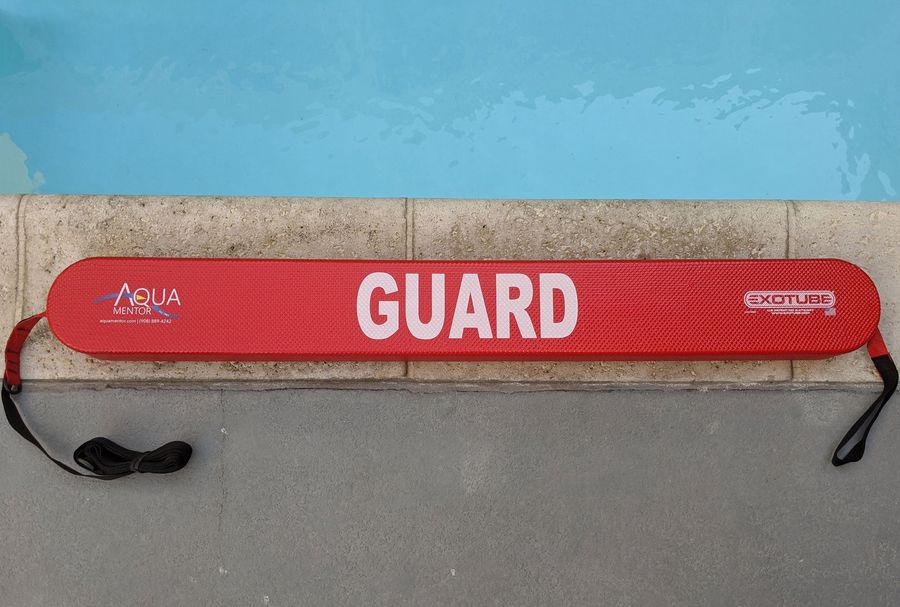
The Aquamentor ExoTube is a 50-inch closed-cell foam rescue tube with brass hardware and replaceable tow lines — built around the spec items in this article. Bulk pricing available for facility orders.
ExoTube specs and pricing →Related
-
Rescue Tubes: The Complete Lifeguard's Guide
Pillar guide covering rescue tube fundamentals.
-
Rescue Tube Sizes: Why Length Matters
40, 45, or 50-inch — when each is the right call.
-
Foam vs. Inflatable Rescue Tubes
Why closed-cell foam is the only correct choice for facility use.