Foam vs. Inflatable Rescue Tubes
There are two construction types of rescue tube on the market. They serve different use cases. For any aquatic facility doing daily lifeguarding, only one is the right choice — and the reasons are about failure modes, not preferences.
The two designs
A closed-cell foam rescue tube is a length of polyethylene foam encased in a vinyl skin. The foam is the structural element — it provides buoyancy through trapped gas bubbles in the cell structure of the foam itself. There is no air space, no bladder, no valve. The skin is there to protect the foam from UV, chlorine, salt, and abrasion.
An inflatable rescue tube is a vinyl, urethane, or PVC bladder that you fill with air, either by mouth or with a small pump. The bladder is the buoyancy. Some inflatable tubes have multiple chambers; some have a single chamber. They typically pack down to a small fraction of their inflated size.
Failure modes
The right way to compare them is by what happens when each one fails.
Foam tube, punctured: nothing changes. The foam is closed-cell — each cell is a sealed pocket of gas. A puncture or cut in the skin lets water reach a few cells at the surface but doesn't propagate. The tube continues to float at full buoyancy. The cut should be patched eventually, but a punctured foam tube can complete the rescue and finish the shift.
Inflatable tube, punctured: buoyancy drops to zero in seconds. A pinhole leak in a single-chamber inflatable means the tube flattens during the rescue. A multi-chamber design degrades more gracefully but still loses substantial buoyancy. In any failure mode, the lifeguard ends up in the water with a victim and no tube.
The puncture failure mode is the entire argument. Lifeguarding equipment exists for the worst-case scenario. Equipment that becomes useless in the worst case is the wrong equipment.
Other factors
Durability
Foam tubes age slowly. The skin fades and eventually cracks under UV exposure, but the foam itself can last a decade with reasonable care. Inflatable tubes age faster — the seams, valves, and bladder material all have shorter service lives. A daily-use inflatable typically needs replacement every 1-2 seasons.
Storage
Inflatables win here. A deflated inflatable tube packs into a small bag, useful for boat-based rescue, individual surfer use, or storage in a fishery patrol vehicle. A foam tube is rigid and takes its full volume regardless of state.
Weight
Roughly comparable when both are deployed and ready for use. The inflatable is lighter when stored, heavier with the pump if one is included.
Cost
A quality foam tube costs $50–$120 at retail depending on size and brand. Quality inflatables run $40–$90. Cheap foam knockoffs and cheap inflatables both exist; both are bad investments. The cost comparison gets reversed over the service life — a foam tube that lasts five seasons is cheaper per year than an inflatable that lasts two.
Maintenance
Foam: rinse off salt or chlorine after use, store out of direct sun, inspect periodically. Inflatables: same plus check valves, check seams, check that the bladder holds pressure overnight, inspect for delamination.
What the standards say
The American Red Cross Lifeguarding Manual references rescue tubes throughout the rescue technique chapters and depicts closed-cell foam tubes in every illustration. The YMCA Aquatic Safety Standards specify "buoyant rescue equipment" and the supplier-recommended models in their guidance documents are universally foam.
Ellis & Associates, who audit thousands of US aquatic facilities annually under their International Lifeguard Training Program, specify rescue tube models that meet their specifications — all are foam-construction. An inflatable tube at an Ellis-audited facility would be flagged as a deficiency.
The American Camp Association aquatic safety guidelines for residential summer camps specify rescue tubes "of closed-cell foam construction" by name.
The pattern is clear and unanimous: every standards body and audit organization in the US specifies closed-cell foam for facility rescue tubes.
Where inflatables fit
Inflatable rescue tubes do have a role. Practical uses:
- Personal rescue equipment for surfers. Surfers in cold-water locations sometimes carry deflated inflatable tubes in board leashes or wetsuit pockets for self-rescue or assisting others. Compactness is the selling point.
- Boat-based search and rescue. Where space is at a premium and gear lives in a dry bag, an inflatable tube takes up less locker space than a foam one.
- Backcountry water-rescue teams. Volunteer fire and rescue teams that occasionally do water rescue may benefit from gear that fits in a smaller go-bag.
None of these are professional aquatic facility lifeguarding. For pool, beach, water park, or summer camp use, the closed-cell foam tube is the only equipment that makes sense.
Comparison table
| Factor | Closed-cell foam | Inflatable |
|---|---|---|
| Performance under puncture | Maintains full buoyancy | Loses buoyancy in seconds |
| Service life (daily use) | 5–7 seasons | 1–2 seasons |
| Cost (initial) | $50–$120 | $40–$90 |
| Cost per year | $10–$25 | $25–$45 |
| Storage volume | Full size, rigid | Compact when deflated |
| Pre-shift prep | Visual inspection | Inflation, pressure check |
| Standards compliance (US) | Yes | No (for facility use) |
Bottom line: If you are buying rescue tubes for an aquatic facility — pool, water park, beach, summer camp — closed-cell foam is the only correct answer. Inflatable tubes have a place in the equipment world, but not at a guard station.
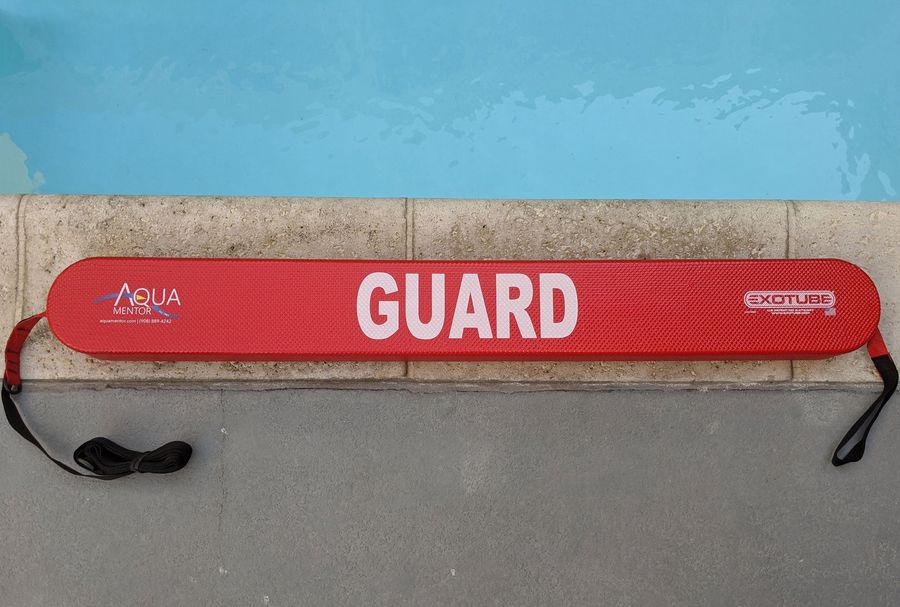
Closed-cell foam, 50-inch length
The Aquamentor ExoTube is a closed-cell polyethylene foam rescue tube with a UV-stabilized vinyl skin, brass clip hardware, and a replaceable tow line. The 50-inch length gives you the buoyancy and wrap margin for deep-water and multi-victim rescues.
Aquamentor (family-owned, Garwood NJ)Related
-
Rescue Tubes: The Complete Lifeguard's Guide
Pillar guide covering all rescue tube fundamentals.
-
Rescue Tube Sizes: Why Length Matters
When to spec 40, 45, or 50 inches.
-
How to Use a Rescue Tube
Approach, contact, control, and tow technique.