How to Use a Rescue Tube
A water rescue with a tube has four phases: approach, contact, control, and tow. The technique varies by victim condition, but the underlying mechanics — and the things that get guards hurt — are the same.
This is a working guide for lifeguards and head guards who want a written reference to pair with in-water training. It is not a substitute for certification. Every guard should be currently certified through the American Red Cross, YMCA, Ellis & Associates, or an equivalent program before performing rescues in a professional setting.
The four phases of a tube rescue
Every in-water rescue with a rescue tube breaks down into the same four phases:
- Approach. Enter the water, swim to the victim, deploy the tube.
- Contact. Make physical contact with the victim and place the tube.
- Control. Stabilize the victim and yourself in the water.
- Tow. Move victim and tube back to the wall, deck, or shore.
What changes between rescue scenarios is how each of these phases is executed. The biggest variable is the victim's condition.
Scenario 1: Distressed swimmer (conscious, responsive)
A distressed swimmer is fatigued or struggling but still aware, still breathing, and still able to respond to verbal commands. They have not yet entered active drowning. Most rescues a guard performs in their career fall into this category.
Approach
Enter the water with a feet-first or stride entry, never a dive (which leaves your eyes off the victim and risks neck injury). Swim head-up so you keep visual contact with the victim. The tube is attached to your shoulder by the strap and trails behind you on its line.
Contact
Stop just outside the victim's reach. Pull the tube in front of you, push it toward the victim, and instruct them clearly: "Grab the tube." Keep yourself behind the tube — you want the buoyant body of the tube between you and the victim's hands at all times. A panicked swimmer can transition from "responsive" to "active drowning" in a few seconds, and the tube is what protects you.
Control
Once the victim has the tube, talk to them. Calm voice, short instructions: "I've got you. Hold the tube. Kick when you can. We're going to the wall." Verbal control is what keeps them in the responsive category and prevents the situation from escalating.
Tow
Tow on your side or your back, with the victim either holding the tube facing you (rear tow, your stronger position) or holding from the side. Use a side stroke or modified breast stroke. Keep the line short — the closer the victim is to you, the more control you have.
Scenario 2: Active drowning (conscious, panicked)
An active drowning victim is in the instinctive drowning response identified by Dr. Frank Pia in the 1970s. The signs are unmistakable once you know what to look for:
- Body vertical in the water, mouth at water level, head tilted back
- No breath available for speech, calling, or waving
- Arms moving laterally, pressing down on the water surface — not waving for help
- Climbing motion, as if trying to ascend an invisible ladder
- Little or no kick
- Body sinks below water level, surfaces, sinks again — typically lasting 20–60 seconds before the victim goes under for good
An active drowning victim cannot grab a tube on instruction. They cannot speak. They will, however, climb on anything in reach. This is the rescue where guards get pulled under, and it's why the technique is different.
Approach
Get there fast. The active drowning window is brief. Enter feet-first, head-up swim, tube trailing.
Contact
Approach the victim from behind whenever possible. Push the tube under their armpits from behind, sliding it horizontally so it crosses the chest. Reach over the tube and clip the buckle around the victim's torso. The tube is now strapped to them — they can climb all they want, the tube is doing the work, and your face is well clear.
If approach from behind isn't possible, approach face-on but keep the tube extended in both hands as a barrier. Turn the victim by their shoulders or armpits as you place the tube; never let them grab you directly.
Control
Once the tube is clipped, the victim's behavior changes within a few seconds. The flotation gives them their head above water, breathing returns, and the climbing motion stops. They will often go quiet, exhausted. This is normal.
Tow
Tow on your back. The victim is on the tube, feet trailing, head out of the water. You are below and ahead of them, kicking and using a modified backstroke pull on the tow line. This position is the safest for both of you because the victim cannot reach you and the tube takes their weight.
Scenario 3: Unconscious or non-breathing victim
Unconscious victims are silent. They are usually face-down or face-up at the surface, or sinking. They do not respond to verbal cues or physical contact. Speed matters because every second affects survival and neurological outcome.
Approach
As fast as you can move while maintaining control. Tube is attached and ready.
Contact
Roll the victim face-up if they aren't already. Place the tube under their torso, perpendicular to their body — the tube becomes a buoyant cradle running across their chest or behind their shoulder blades. The flotation alone may bring them to the surface; you do not necessarily need to clip the buckle.
Control
Check airway and breathing. If non-breathing, begin in-water rescue breathing immediately. The tube becomes a stable platform — the buoyancy keeps the victim level and lets you maintain head position and seal the breaths.
Tow
Continue rescue breathing as you tow. Speed is balanced against the quality of the breaths — a tow that's too fast disrupts the seal. Two-guard rescues are dramatically better here: one guard tows, one delivers breaths. If you have a backup guard available, signal them in.
Things guards get wrong
Recurring mistakes from facility audits and case reviews:
- Diving the entry. Dives lose visual contact with the victim and cause neck and spine injuries to guards. Stride or compact entry only.
- Letting go of the tube during the swim. The tube must arrive with you. A guard who reaches the victim without their tube has nothing.
- Approaching face-on with a panicked victim. Approach from behind whenever possible.
- Underestimating the line length. Too much line and the tube drifts; too little and the tube is ahead of you and useless. The tow line should be just long enough that the tube floats free behind you during swim and reaches your hands when you stop to deploy.
- Not training with the actual tube. The tube on the wall during real rescues should be the same tube guards trained with last week. Training with a different model creates muscle-memory failures.
Drill it cold. The phrase "you fight how you train" is a cliché because it's true. Run scenarios at the start of every shift if you can — five minutes of dry-land approach drills, weekly in-water scenarios. The technique on this page is what gets done correctly when the guard's heart rate is at 180 and they have eight seconds to make a decision.
Equipment notes
Technique is downstream of equipment. A few specifics:
- Tube length affects technique. A 40-inch tube is harder to wrap around a large adult victim. A 50-inch tube gives the guard more material to work with and more buoyancy to support a multi-victim scenario. See rescue tube sizes for the full breakdown.
- Clip hardware matters. Brass or stainless clips don't seize in salt water or chlorine. Plastic clips bind under load. If your tube clips are sticking, replace them.
- Tow line length is adjustable. Most quality tubes ship with a 6–8 foot line and an adjustment cleat. Short guards or tight pool layouts may want shorter lines.
- Closed-cell foam only. An inflatable tube can fail at the worst possible moment. We cover the comparison in foam vs. inflatable.
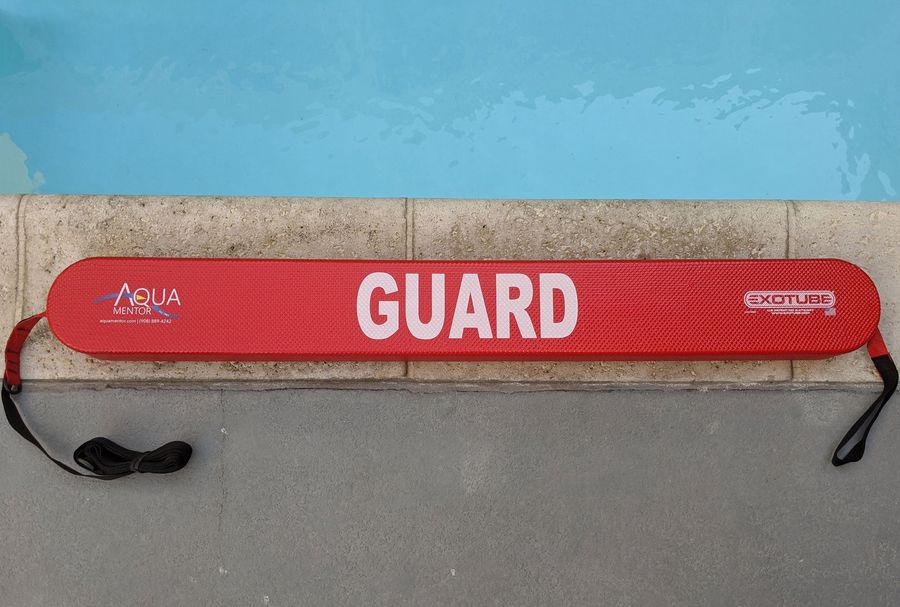
Considering a 50-inch rescue tube?
The ExoTube from Aquamentor is a 50-inch closed-cell foam rescue tube with brass hardware and a replaceable tow line — built for the deep-water and multi-victim cases where the extra length earns its keep.
Available in any color, with your logoRelated
-
Rescue Tubes: The Complete Lifeguard's Guide
The pillar guide — what a rescue tube is, types, sizes, and how to choose one.
-
Rescue Tube Sizes: Why Length Matters
When 50 inches is the right call and when 45 will do.
-
Choosing Rescue Tubes for Your Aquatic Facility
A buying framework for head guards and facility managers.